News
Behind the Headlines
Two-Cents Worth
Video of the Week
News Blurbs
Articles
Testimony
Bible Questions
Internet Articles (2017)
Internet Articles (2016)
Internet Articles (2015)
Internet Articles (2014)
Internet
Articles (2013)
Internet Articles (2012)
Internet Articles (2011)
Internet Articles (2010)
Internet Articles
(2009)
Internet Articles (2008)
Internet Articles (2007)
Internet Articles (2006)
Internet Articles (2005)
Internet Articles (2004)
Internet Articles (2003)
Internet Articles (2002)
Internet Articles (2001)
|
|
Kellogg's wants to play politics with food
Kelloggs Foods (most notably known as a breakfast food company) has decided to play politics with its consumer base by pulling its ads from the popular Brietbart.News website because, it appears, Steve Bannon, who took over when Andrew Brietbart died, took a position as one of president-elect Donald Trump's top advisers. Brands which spend advertising dollars on the increasingly popular Brietbart News Network (that is closing in on 20 million unique visitors per month, which translates into 45 million hits per month) has now come under attack from the leftwingnuts who use social media as a tool of vengeance. The cyber-attacks started when Bannon's new role with the President-elect Trump was announced by Fox News last month.
On Tues., Nov. 29 Kellogg's (which makes Pringles™ Potato Chips, Eggo™ Waffles, Pop Tarts®, Chees-It®, MorningStar Farms™, Famous Amos™, Mother's Cookies™, Keebler™ Cookies and Crackers, Mueslix® Brand cereals, and a host of diet foods as well as many of America's more popular breakfast cereals) announced it would boycott Brietbart News because it stoked racist and anti-semitic emotions through its choice of headlines and racist verbiage.
Kellogg's, which has long been known as a leftwing elite political donor, joined the social progressive anti-Trump fray by announcing, on Nov. 29, that it was pulling all of its advertising from the Brietbart News Network because Brietbart's conservative readers are apparently not aligned with Kellogg's core societal views and values—at least, not according to Kellogg's spokeswoman Kris Charles who, when she blacklisted Brietbart News said, "We regularly work with our media-buying partners to ensure that our ads do not appear on sites that aren't aligned with our values as a company, We recently reviewed the list of sites where our ads can be placed, and decided to discontinue advertising with Brietbart.com. We are working to remove our ads from that site." And, today, conservative consumers are working to discontinue the last vestige of Kellogg's products from their kitchens. The left, which thinks every person in the world believes the dribble they expound is virtually shocked when they find out the little people didn't buy their lies, believe conservatives, who've never had their business, need it—or moreover, want it.
Most social media ad buyers (like those employed by leftwing Kellogg's, Allstate™ Insurance [formerly part of the now pretty-much defunct Sears & Roebuck® chain which survived only because it merged with K-Mart], Target Stores®, Earthlink™, and other liberal merchant princes) are only interested in the top news websites which cater to conservative news junkies. They want their ads placed on the hottest internet properties—where the lion's share of the audience goes for real news. About 90% of those top websites are conservative in nature. So, don't think Kellogg's advertising buyers didn't check out the audience demographics and household incomes of the audiences that hang out on Brietbart or sites like the Drudge Report (which was the top dog news site prior to Andrew Brietbart.
Editor-in-Chief Alexander Marlow noted that Kellogg’s could offer no examples of how Breitbart’s 45 million monthly readers fail to align with the breakfast maker’s values. Marlow said, "...the move appears to be one more example of an out-of-touch corporation embracing false left-wing narratives to cynically smear the hard working Americans that populate this nation’s heartland."
The Kellogg boycott was Marlow's idea. He added, "...Breitbart News is the largest platform for pro-family content anywhere on the Internet. We are fearless advocates for traditional American values, perhaps most important among them is freedom of speech, or our motto ‘more voices, not less.’ For Kellogg’s, an American brand, to blacklist Breitbart News in order to placate left-wing totalitarians is a disgraceful act of cowardice. They insult our incredibly diverse staff and spit in the face of our 45,000,000 highly engaged, highly perceptive, highly loyal readers, many of whom are Kellogg’s customers. Boycotting Breitbart News for presenting mainstream American ideas is an act of discrimination and intense prejudice. If you serve Kellogg’s products to your family, you are serving up bigotry at your breakfast table."

Meet the face of Hurricane Matthew...
The ominous photo of the face of Matthew (on the right) surfaced on Tuesday, Oct. 4, 2016 as Hurricane Matthew was making its way over western Haiti. 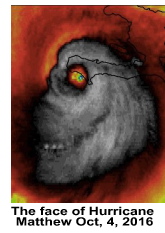 Scores of meteorologists were tracking radar images of the storm, forecasting its journey up the East coast of the United States, attempting to determine where this deadly storm would make landfall.
A senior meteorologist for The Weather Channel, Stu Ostro,
Scores of meteorologists were tracking radar images of the storm, forecasting its journey up the East coast of the United States, attempting to determine where this deadly storm would make landfall.
A senior meteorologist for The Weather Channel, Stu Ostro,  said as he was plotting Matthew's likely
course through infrared satellite imagery of the face of the storm—only to discover that Matthew really had a face. An eerie one.
said as he was plotting Matthew's likely
course through infrared satellite imagery of the face of the storm—only to discover that Matthew really had a face. An eerie one.
As he was looking at the satellite imagery of Hurricane Matthew, Ostro discovered that the storm cloud of Matthew appeared like a bizarre, smiling skull with the eye of the storm appearing as the eye of the image. The image of the smiling ghoul was photographed by NASA Earth Science Office. Ostro, who posted the photo of Matthew on Twitter on the 4th shortly after uploading the image onto his computer, making it clear to those who would see it once he posted it on Twitter, the image was an undoctored weather satellite image, noting that it had not been photoshopped in any way.
As Matthew swept over western Haiti, authorities estimate that over 842 people in the Caribbean islands died. The storm then slammed into Cuba with 24-foot waves and a devastating storm surge accompanied with torrential rains. Eleven more died in Cuba. By the time Matthew was downgraded to a tropical storm, the total death toll attributed to the storm was estimated at over 1,000—with many of those in the United States attributed to severe flooding in Georgia, South Carolina, North Carolina and Virginia. The financial and economic damage caused by Hurricane Matthew exceeded $6 billion. Yes, I can see why "evil" wore a smile when it visited America and its Caribbean neighbors.
Kansas Judge rules States can't block
illegals from voting in national elections.
US District Court Judge Julie Robinson, the first black federal court judge in that State ruled on Tuesday, Sept. 27, 2016 that an injunction she issued earlier this year barring Kansas from enforcing their April 18, 2011 Secure and Fair Elections Act was now permanently enjoined. On May 17, 2016 The ACLU filed a lawsuit against the State of Kansas arguing that the State could not enact a State law interfering with a federal election. A state court judge agreed with the ACLU that Kansas Attorney General Kris Kobach lacked the legal authority under State law to to keep "federal registrants" (i.e., illegals without standing) from voting in a federal election.
I don't know who is more stupid—the ACLU, the unnamed State judge or the Bush-43 appointed US District Court judge, Julie Robinson, for the District of Kansas who doesn't seem to know that the State's authority to block unqualified voters from voting in federal elections comes from the United States Constitution, not State law. The rights to determine the rule by which members of Congress and the President are balloted and voted for are determined by Article I, Section 4 and Article II, Section 1 of the Constitution. The federal government, may change the "time" (day) of the Election, but not the "manner" of the election—until a Constitutional amendment is ratified by 3/4ths of the States. The State legislatures alone determine the manner in which the voters vote, and how the voter verifies that he or she is constitutionally eligible to vote.
Judge Robinson ruled that Kansas violated the National Voters' Registration Act of 1994 (the National Motor-Voter Act). She was wrong. Bill Clinton's Democratic majority 103rd Congress violated Article I, Section 4 of the Constitution since the federal government had no authority to enact a law which allowed them to change the manner in which voter registered to vote—and verified their eligibility. From the moment Kansas enacted the Secure and Fair Elections Act, it became a constitutional issue. The only law whose legality should have been in question was not the Secure and Fair Elections Act but the National Voters' Registration Act of 1993 since it was the only law that violated Article I, Section 4 of the Constitution. The Constitution of the United States requires that to vote, you must be a lawful citizen of the United States, and produce the evidence to prove that you are. The plaintiffs argued that federal law does not require voting registrants to produce more documents than they would need to secure a driver's license. Fair enough. But not the 1993 ACORN Motor Voter version flaunted by candidate Barack Obama. None of the World Trade Center bombers had valid US identification. When the USA Patriot Act was legislated, new regulations for securing either a driver's license or a US identity card were legislated. To get a drivers' license today, you need to produce [1] a valid, State-issued birth certificate, [2] a State-issued photo ID, preferably the driver's license which is about to expire), [3] two or three current utility bills containing the name and address of the person seeking the driver's license (preferably an electric bill and either a telephone bill, water bill or gas or electricity utility bill. But, first and foremost is the photo identification. Without a picture ID which proves you are who you say you are, none of the other documents can legally generate the driver's license. (If the applicant is from another country, the passport which granted the foreigner access to the United States [and their naturalization papers]) will be what the Department of Motor Vehicles will expect to see.
The State court judge who, earlier this year, ruled that Kobach lacked the legal authority under State law to keep federal registrants from voting was wrong. What the State court judge failed to realize is that only the legislature of the State has the constitutional authority to determine what evidence of identity and citizenship the applicant must produce to be legally recognized as a lawful "federal registrant" for voting purposes. That begins by establishing your legal domicile. Because the voting precinct you vote in is determined by where you live. This case, and that argument needs to be in the US Supreme Court before the 13,000 aliens become 25,000 to 50,000 illegal voters in Kansas, and a half million more appear in Alabama, Arizona, and Georgia.
US citizens lose protection of a good Bush-43 law, caused by a bad Bush-43 law on creating, then repealing, country-of-origin of meat labels
There comes a time when the US people need to make tough choices. Part of those choices are firing crooked members of Congress. Those are the easy choices. The first two which need to be fired are Sen. Pat Roberts [R-KS] who, unfortunately does not come up for reelection until 2020. If you get e-coli poisoning from meat between now and then, and you're a Kansas resident, you'll remember to boot Roberts out of office during the primary. Roberts has been an opponent of "country of origin" labels since they were signed into law by Bush-43 in 2002 in order to protect Americans from buying unhealthy meat, poultry and fish products from unsanitary third world countries. The Bush-43 law didn't extend to poultry and, particularly fish, until 2009 (so please don't think protecting you from sewer fish was a protection provided by Barack Obama, who has been fighting to overturn the law since the law went into effect.)
Roberts, and anyone who voted to hide the country of origin of foreign products needs to be removed from office, and a federal law needs to be enacted to take away any federal pension from politicians caught doing quid pro quos for industrialists or their lobbyists . Let the crooked US meat peddlers who are selling US meat products to foreign countries or profiting from selling Chinese or Thai beef in the United States, put Roberts on their corporate pension plans—or strip them of their US citizenship and let them join the Parliaments of the countries for whom they are actually working by screwing the American people and calling it "representative government."
Then there's Sen. Debbie Stabenow [D-MI] who wants to make sure Canadian beef producers can sell their cattle to Americans who have more than enough beef to feed the American people. Wonder what Canadian lobbyists are feeding her campaign re-election fund?. Stabenow doesn't run for reelection until 2018, so you'll likely forget that the sewer-raised tilapia from China that puts you or your children in the hospital with e-coli will likely be due to the fact that not only do the meat packers but the poultry and fish mongers don't have to tell you what disease-infested swamp hole their products came from.
The House version of the meat label repeal, HR2393, passed on a vote of 300 ayes and 131 nays, was proffered as The Country of Origin Labeling Amendments Act of 2015 by Rep, K. Michael Conway [R-TX[ (who should be forced to eat tamales and tortillas for the rest of his life) and Jim Costas [D-CA] who probably already does. Fortunately, both of them are up for reelection in November. Both need to be defeated in their primaries. The American people need to make it clear to every municipal, county, State or federal legislator, governor and President, they are elected BY THE PEOPLE even though they are financed with dirty money from the princes of industry, and the barons of banking and the courtesans of commerce who always work against the people and for the big-bucks donors who bribe them. And, the American people need to be prepared to recall and remove any thief they inadvertently elect to public office. And when they charge the politician with malfeasance, they also need to charge the fat cat with the big bucks and the lobbyist who doles out the political graft for the giving and taking of bribes.

Copyright © 2009 Jon Christian Ryter.
All rights reserved.